
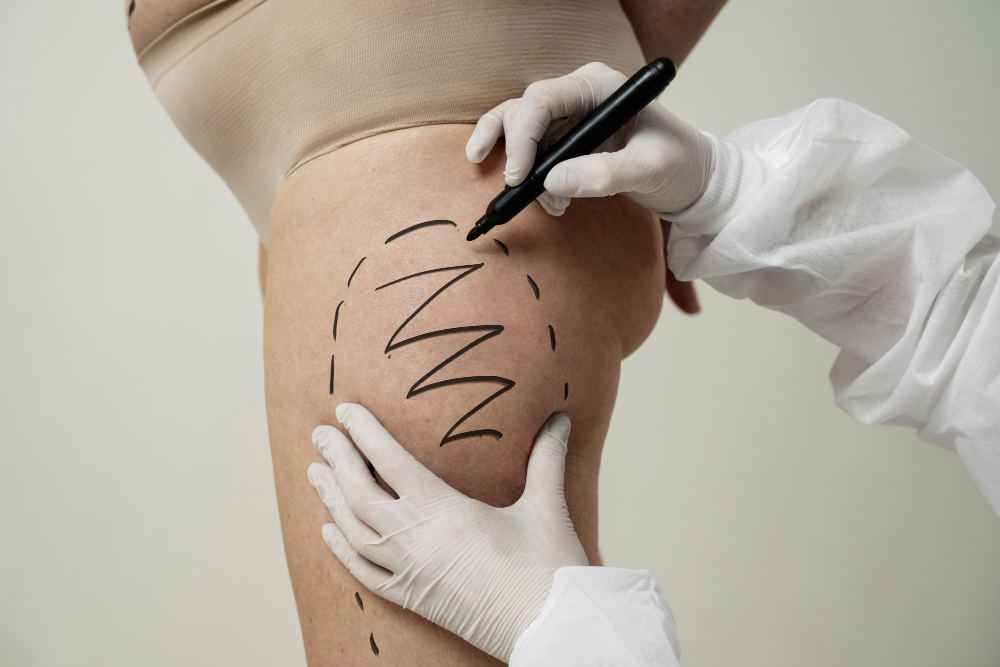
Lipedema is a chronic, progressive fat-tissue disorder that causes symmetrical, disproportionate fat accumulation in the legs, hips and arms — almost exclusively in women. Because it does not respond to diet or exercise and is often mistaken for simple weight gain, many patients go years without a correct diagnosis.
At his clinic in Istanbul, Op. Dr. Ali Ertan Capar accurately stages lipedema and treats it with lymph-sparing surgical techniques tailored to each patient.
Lipedema is a chronic condition in which the fat tissue under the skin increases abnormally and symmetrically, accompanied by pain and tenderness. It is sometimes called 'painful fat syndrome'. Its hallmark is fat that builds up between the waist and the ankles while sparing the feet and hands, creating a distinct 'cuff' or bracelet sign at the ankle.
Lipedema is classified into four stages based on changes to the skin surface and fat tissue. Correct staging drives the treatment plan.
|
Stage |
Clinical appearance |
|
Stage 1 |
Skin surface is smooth and soft; the underlying fat layer is enlarged. |
|
Stage 2 |
Skin shows indentations (orange-peel look) with palpable nodules underneath. |
|
Stage 3 |
Large fat masses and skin folds develop; the limb becomes visibly deformed. |
|
Stage 4 |
Lipo-lymphedema — the lymphatic system is also affected; swelling and tissue firmness increase. |
The exact cause is not fully understood, but a combination of genetic predisposition, hormonal factors and environmental influences is thought to be responsible. Because it occurs almost only in women and typically begins during hormonal transitions such as puberty, pregnancy or menopause, estrogen is believed to play a key role. A family history of lipedema increases the risk.
Lipedema and lymphedema are often confused but differ fundamentally. In lipedema the core problem is abnormal fat accumulation, usually symmetrical in both legs, and the feet are spared. In lymphedema, lymph fluid accumulates, it can be one-sided, and the feet also swell. Advanced lipedema can involve the lymphatic system and progress to lipo-lymphedema (stage 4).
With obesity, weight loss slims the whole body; with lipedema, the legs do not respond to dieting. Lipedema fat is also painful, whereas obesity-related fat is usually painless. The two can coexist, which complicates diagnosis and makes specialist assessment important.
In early stages and as preparation for surgery, conservative methods relieve symptoms and slow progression:
These reduce pain and swelling but do not remove the diseased fat tissue itself. For lasting results in advanced stages, surgery is required.
Lipedema surgery is different from cosmetic liposuction: the goal is to remove only the diseased fat while protecting the lymphatic vessels and connective tissue. That is why it is called 'lymph-sparing' or 'lympho-selective' liposuction. Op. Dr. Ali Ertan Capar plans the procedure with fine micro-cannulas and tissue-preserving techniques based on each patient's stage and anatomy.
For advanced stages, treatment may be planned across more than one session for safety and the best result.
Most patients are on their feet within a few days and back to light activity soon after; desk work is usually possible within one to two weeks. Swelling peaks around day three and then subsides gradually over three to six months. Wearing compression garments and supporting lymphatic drainage improves results. Surgery does not 'cure' the disease, but by removing the diseased fat it markedly reduces pain, restricted movement and further progression.
Istanbul has become a leading destination for lipedema surgery thanks to experienced plastic surgeons and modern lymph-sparing techniques. International patients are usually cleared to fly five to seven days after surgery, once drains are removed and incisions are dry. Op. Dr. Ali Ertan Capar evaluates each patient's stage and history and builds a personalised plan, coordinating the surgical and recovery timeline for those travelling from abroad.
Q: Which doctor treats lipedema?
A: Lipedema is managed mainly by plastic, reconstructive and aesthetic surgeons, along with vascular and physical-medicine specialists. For surgical treatment (lymph-sparing liposuction), a plastic surgery evaluation is recommended.
Q: Does lipedema go away with diet and exercise?
A: No. Diet and exercise slim the upper body but do not reduce the pathological fat in lipedema-affected areas. Conservative methods ease symptoms; lasting resolution in advanced stages requires surgery.
Q: Is lipedema surgery safe?
A: When performed by an experienced plastic surgeon using lymph-sparing techniques and correct staging, lipedema surgery is a safe procedure. As with any surgery, thorough examination and planning are essential.
Q: Will lipedema come back after surgery?
A: The diseased fat cells that are removed do not return. However, hormonal changes, ageing or weight fluctuations can create new fat over time, so following lifestyle guidance matters.
Q: How much does lipedema surgery cost in Turkey?
A: Cost depends on the stage, the number of areas treated and the number of sessions required. A precise plan and quote are given after an in-person or online evaluation.